

School-Based Mental Health
The Office of School-Based Mental Health stands as a pivotal force in fostering improved student well-being across the educational landscape through a multi-tiered system of support. The office offers technical assistance, consultation, and training to equip educators with the tools and knowledge necessary to address the challenges of mental health in educational settings. This office directs the creation and implementation of comprehensive mental health programs within schools and guides schools to measure program effectiveness through oversight and evaluation. This office navigates state and federal policies to ensure a comprehensive understanding that forms the foundation for school-based mental health initiatives.
Recognizing the interconnected nature of mental health systems, the office takes a collaborative approach to ensure a holistic response to mental health needs, enriching the support network available to students. Through leadership, collaboration, advocacy, and expert guidance, this office strives to create an educational landscape where students can thrive emotionally and academically.
School mental health operates under three priorities:
- Protect access to strong instruction: School mental health helps students be available for learning by removing barriers that impede learning.
- Give students opportunities to succeed: When universal supports are not enough, school mental health and behavioral supports are targeted and matched to the student's needs. Meeting needs increases student success.
- Put expertise where it has the greatest impact: Specialized professionals provide specialized supports.
School Based Mental Health Plan
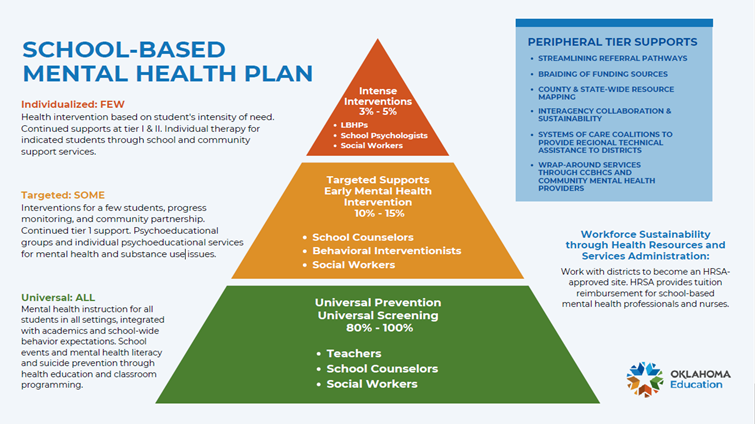
The plan is based on a Multi-Tiered Systems of Support (MTSS) model that will provide screening and prevention support (Tier 1) for all students, targeted supports for students who require more significant intervention (Tier 2), and individualized interventions for those students who have the greatest need for mental health services (Tier 3). Tier 3 interventions, including wrap-around services, will be addressed by the ODMHSAS's Systems of Care partners. With the state-wide plan, the Office of School-Based Mental Health intends to help students and families across Oklahoma lead healthier, more productive lives. In turn, the plan will enhance student, school, district, and state outcomes by improving attendance rates, graduation rates, and school climate, enabling students and families to receive the help they need as efficiently and effectively as possible.
Workforce Development
- Provide pathways for schools to increase the health and mental health workforce by establishing student loan forgiveness programs at school sites.
- Help schools retrain licensed mental health professionals to tailor their services to the school system.
Collaboration
- Help schools expand partnerships with mental health facilities to provide site-level mental health support and wrap-around services.
- Help schools participate in local System of Care coalitions to help districts build local crisis response systems and resource access in their communities.
Support
- Provide a toolkit for schools to plan and build their mental health programs.
- Provide education and ongoing technical assistance to help schools build out their mental health programs.
- Pair schools with mentor schools that already have an established school mental health program.
Evaluation
- Track the performance measures in school mental health services and training provided in school districts participating in school-based programs.
- Track the number of Mental Health Crisis Protocols submitted by districts.
- Track the number of Mental Health Crisis Protocols submitted by districts.
Student Mental Health Guidance Documents
Mental Health Legislation became effective July 1, 2022. We recognize that many questions remain regarding this new legislation and the implementation of new policies and procedures in your schools. In response, the Oklahoma State Department of Education has created a guidance document aligned to the recently released Red Book mental health legislation components.
Download Model Policy Guidance

The Oklahoma State Department of Education is proud to introduce the School-Based Mental Health Toolkit — an easy-to-navigate guide designed to help schools build, strengthen, and sustain mental health supports for students. Whether you're just getting started or looking to enhance existing services, this toolkit equips educators and school teams with a broad framework and resources needed to foster safe, supportive, and resilient learning environments.
Educator Wellness

Educator Wellness Resource Library
Educator Wellness Resource Library
Additional Resources / Links
All Mental Health Protocols are required to be uploaded to Single Sign-On biannually.
Memorandum of Understanding for Mental Health Partnerships
This document provides an example of an MOU between a school district and partnering community mental health agencies. This document does not constitute legal advice and is for guidance purposes only.
This document is required for any school seeking reimbursement for counseling services. The manual provides detailed information on establishing a school mental health program, with a focus on the requirements for receiving reimbursement.
School-Based Mental Health Implementation Overview
School-based mental health services are provided through a Multi-Tiered System of Support (MTSS). MTSS is a prevention-based framework structured to serve the needs of all students, and it is not a one-size-fits-all program. In equity-based MTSS, tiers organize students' needs and allocate available resources. An equity-based MTSS framework should build upon the school community's strengths, align with the students' needs while honoring all cultures, and move the future of education forward (McCart & Miller, 2020).
Schools implementing an MTSS framework should focus on embedding trauma-informed principles and strategies to address students' and school communities' behavioral and learning needs in these components:
- Screening
- Multi-Disciplinary Teams (aka MHIT Teams)
- Data-Based Decision Making
- Evidence-Based Practices
- Continuous Improvement Cycle
- Using MTSS is both a prevention and intervention framework. MTSS is used to address the biological, behavioral, and learning needs of all students and their school communities. The framework has been scientifically proven to be highly effective in improving all student outcomes, addressing limited resources, and providing enhanced professional development in rural and suburban schools. The goals of trauma-informed and multi-tiered behavioral support share a similar scientific basis. Both practices and interventions create a safe and predictable school climate, enhance the social environment, and reduce problematic behavior (McIntosh, Ty, & Miller, 2014).
School-Based Mental Health Implementation Model
Model 1: Mental and Behavioral Health Agency Partnership Model
- A mental health agency partners with the district through a Memorandum of Understanding (MOU) to provide direct services to students.
- The district appoints an SBMH Program Coordinator to serve as a liaison between the agency provider, district personnel, families, and students.
- The agency maintains an active Medicaid Provider Number for Counseling Services.
- The agency acts as the billing agent for all services provided.
- No OHCA certification approval is required by the district, and the district is not billing for services.
Model 2: School-Employed Provider Model
- A Licensed Mental Health Professional (LMHP) is employed by the district to deliver direct services to students.
- The district appoints an SBMH Program Coordinator to act as a liaison between district personnel, families, and students.
- The district holds an active Medicaid Provider Number for Mental and Behavioral Health Services.
- The district handles billing for services rendered. OHCA Certification approval is required by the district.
Model 3: Hybrid Model- School-Employed Providers and Community Partnership
- A district-employed LMHP provides direct services, while a mental health and behavioral health agency also partners with the district through an MOU to offer additional services.
- The district designates an SBMBH Program Coordinator to act as a liaison between the agency provider, district personnel, families, and students.
- Both the district and the mental health agency maintain active Medicaid Provider Numbers for Counseling Services.
- Billing responsibilities are managed by either the district, the agency, or both, depending on the arrangement. This arrangement requires a written contract to outline who is responsible for what.
- The agency and district must coordinate care to ensure services are not duplicated, that services that occur in school focus on school behaviors/issues, and outside behaviors/issues are addressed by the agency.
- OHCA Certification approval is required by the district.
