Targeted Support and Improvement (TSI) and Additional Targeted Support and Improvement (ATSI)

To identify schools that need Targeted Support and Improvement, Oklahoma will analyze school performance within each subgroup annually as required by the ESSA [i.e., race/ethnicity (White, Hispanic/Latino, Black/African American, American Indian, Asian/Pacific Islander and Two or More Races), socioeconomic status, disability and English learners (ELs)]. 

Oklahoma defines sites as consistently low performing when at least one subgroup (as listed above) in a school is in the bottom 10% of that respective subgroup for three years in a row. The state will define a “consistently underperforming” subgroup as a subgroup that falls below the 10th percentile for that subgroup for three (3) consecutive years.

Schools can exit TSI designation when the underperforming student group for which they were identified demonstrates improvement that:

  • (1) brings the school out of the bottom 10% for that particular student group

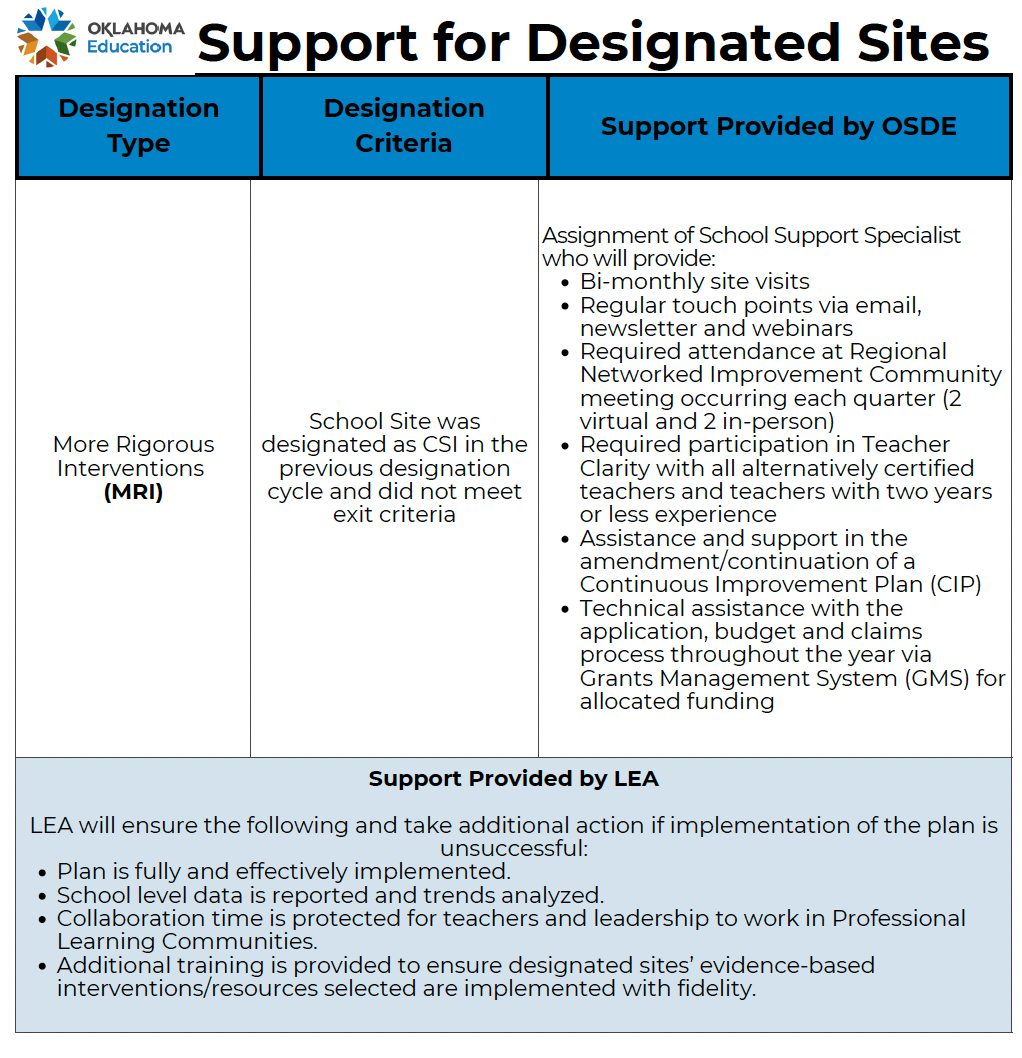
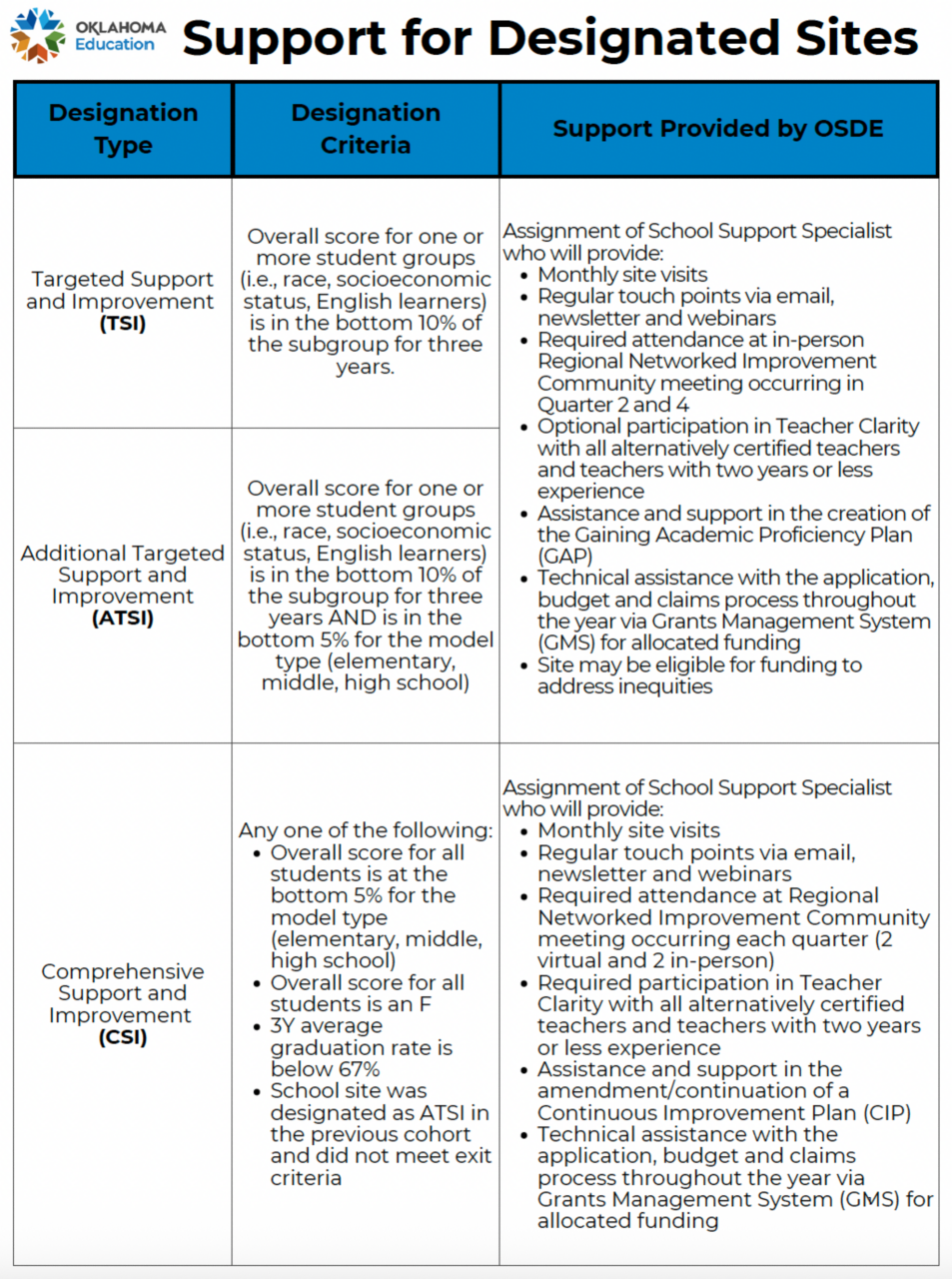
Overall score for one or more student groups (i.e., race, socioeconomic status, English learners) is in the bottom 10% of the subgroup for three years AND is in the bottom 5% for the model type (elementary, middle, high school)

Within an improvement cycle, schools can exit ATSI designation when the underperforming student group for which they were identified demonstrates improvement that:

  • (1) brings the school out of the bottom 5% for that particular student group, and 
  • (2) that the absolute performance of that student group is higher than the performance demonstrated during identification for two consecutive years. 

This ensures that student groups that are remaining stagnant or regressing in performance are not exited simply due to the other student groups declining in performance. Because ATSI schools will have the opportunity to exit annually, the OSDE will monitor schools who are at risk for both ATSI and TSI identification and inform LEAs accordingly.  

TSI and ATSI schools will receive support from a school support specialist which will include:

  • Monthly site visits
  • Regular touchpoints via email, newsletter and webinars
  • Required Attendance at in person Regional Networked Improvement Community meeting occurring in Quarter 2 and Quarter 4
  • Optional participation in Teacher Clarity with all alternatively certified teachers and teachers with two years or less experience
  • Assistance and support in the creation of the Gaining Academic Proficiency Plan- (GAP)
  • Technical assistance with the application, budget and claims process throughout the year via Grants Management System (GMS) for allocated funding
  • Site may be eligible for funding to address inequities

TSI: Annually

ATSI: Every three years


About School Report Cards

Just as students' report cards provide a snapshot of their school performance, the Oklahoma School Report Cards show how public schools across Oklahoma are serving students in a variety of areas. The dashboard available here is similar to the dashboard of a car displaying key information. Users can click through to learn more.

Oklahoma's school report cards are measured across multiple indicators, including academic achievement, academic growth, chronic absenteeism, progress in English language proficiency assessments, postsecondary opportunities, and graduation. Measured at different points, indicators work together to provide a snapshot of school performance. Each of these indicators receives a specific point value that translates to a letter grade.

At the core of the Oklahoma School Report Cards is the belief that all students can grow and all schools can improve. While no student report card tells the full story of a child, no school report card tells the full story of a school. Education is far more than a single score or letter grade, but it is important that families and communities can see both strengths and areas that need support and improvement.

In addition to accountability-specific indicators, contextual information including per-pupil expenditures, educator qualifications, NAEP, and CRDC data are also displayed. Doing so allows users to understand a school's successes and challenges from several perspectives.


Report Card Indicators

Last Modified on Aug 28, 2025